discrimination

Type: 
Topical Term
Subfield: 
a
Alias: 
discrimination

Recognizing microaggressions

Readers will learn what microaggressions are, why they're bad news, and how to handle them.

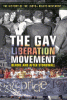
The gay liberation movement

before and after Stonewall
This book explains the emergence of the modern gay liberation movement, from its early years prior to the Stonewall riots of 1969 and its continuation into the 1970s.

The LGBT rights movement

Examines how and why social change occurs and the lasting influence of the LGBT movement on mainstream society.

Nobody

casualties of America's war on the vulnerable, from Ferguson to Flint and beyond
2017
"Scholar and journalist Marc Lamont Hill presents [an] ... analysis of race and class by examining a growing crisis in America: the existence of a group of citizens who are made vulnerable, exploitable and disposable through the machinery of unregulated capitalism, public policy, and social practice [and] ... shows how this Nobody class has emerged over time and how forces in America have worked to preserve and exploit it in ways that are both humiliating and harmful"--.

Cicada

"Cicada is overworked, under appreciated, and generally discriminated against--but after seventeen years he gets to return to the forest, and laugh at the humans"--Provided by publisher.

LGBT discrimination

Explores discrimination based on the LGBT community, including what it entails, how it manifested, how widespread it is, the effects on people, and how to address the problem.
Cover image of LGBT discrimination

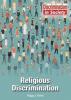
Religious discrimination

2019
Religious discrimination affects people of all different faiths, from Judaism and Christianity to Islam, whose followers are known as Muslims. Research has shown that Muslims face religious discrimination the most of any religious group, followed by Jews. Religious Discrimination examines what this discrimination entails, how it is manifested, how widespread it is, how it affects real people, and efforts to address this discrimination.
Cover image of Religious discrimination

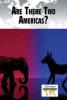
Are there two Americas?

2018
Introduces the reader to all sides of contemporary controversies about, are there two Americas, in an objective and comprehensive way.
Cover image of Are there two Americas?

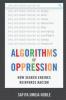
Algorithms of oppression

how search engines reinforce racism
"In Algorithms of Oppression, Safiya Umoja Noble challenges the idea that search engines like Google offer an equal playing field for all forms of ideas, identities, and activities. Data discrimination is a real social problem. Noble argues that the combination of private interests in promoting certain sites, along with the monopoly status of a relatively small number of Internet search engines, leads to a biased set of search algorithms that privilege whiteness and discriminate against people of color, especially women of color. Through an analysis of textual and media searches as well as extensive research on paid online advertising, Noble exposes a culture of racism and sexism in the way discoverability is created online. As search engines and their related companies grow in importance-operating as a source for email, a major vehicle for primary and secondary school learning, and beyond-understanding and reversing these disquieting trends and discriminatory practices is of utmost importance"--Back cover.
Cover image of Algorithms of oppression

Unequal justice

2018
A comprehensive look at how the legal system can go wrong.
Cover image of Unequal justice

Pages

Subscribe to RSS - discrimination