political culture

Type: 
Topical Term
Subfield: 
a
Alias: 
political culture

The citizen machine

governing by television in 1950s America
2010
Describes the role that early television programming played in post-war American politics.

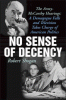
No sense of decency

the Army-McCarthy hearings : a demagogue falls and television takes charge of American politics
2009
Analyzes the 1954 Army-McCarthy hearings and Joseph McCarthy's campaign of fear that was covered by the news media for thirty-six days, describing television's impact on government and how television helped to transform American politics.

The liberal hour

Washington and the politics of change in the 1960s
2009
Examines the progressive political climate in the United States during the 1960s, discusses the numerous government initiatives that were established, and explains why a time of such great change ended so quickly.

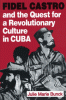
Fidel Castro and the quest for a revolutionary culture in Cuba

1994
Examines the four strategies used by Fidel Castro's regime to transform Cuban culture, identifying the principle targets of each strategy and its ultimate impact on Cuban culture.

Fixed ideas

America since 9.11
2003
Presents a commentary and critique of the actions of the U.S. government since the terrorist attacks of September 11, 2001, arguing that the Bush administration has used the tragedy as a springboard for pushing through its domestic and foreign policies while questioning the patriotism of any and all opponents.

The king's three faces

the rise & fall of royal America, 1688-1776
2006
Argues that colonial society in America from 1688 to 1776 created a political culture that was strongly influenced by Great Britain's monarchs until the Revolutionary War led to a break with the king.

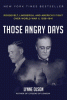
Those angry days

Roosevelt, Lindbergh, and America's fight over World War II, 1939-1941
2013
Traces the crisis period leading up to America's entry into World War II, describing the nation's polarized interventionist and isolationist factions as represented by the government, in the press, and on the streets.

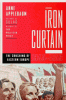
Iron curtain

the crushing of Eastern Europe, 1945-1956
2012
A history of how Communism took over Eastern Europe after World War II and transformed the individuals who came under its sway.

The birth of modern politics

Andrew Jackson, John Quincy Adams, and the election of 1828
2009
Presents a detailed analysis of the 1828 presidential campaign between southwestern frontiersman Andrew Jackson and New England aristocrat John Quincy Adams that officially established a pattern in which two nationally organized political parties would vie for power against one another.

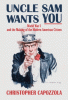
Uncle Sam wants you

World War I and the making of the modern American citizen
2008
Examines the American political structure and the home front during World War I, describing the government's attempts to instill duty and obligation into the people, the formation of the Selective Service, and the large number of conscientious objectors and antiwar radicals.

Pages

Subscribe to RSS - political culture